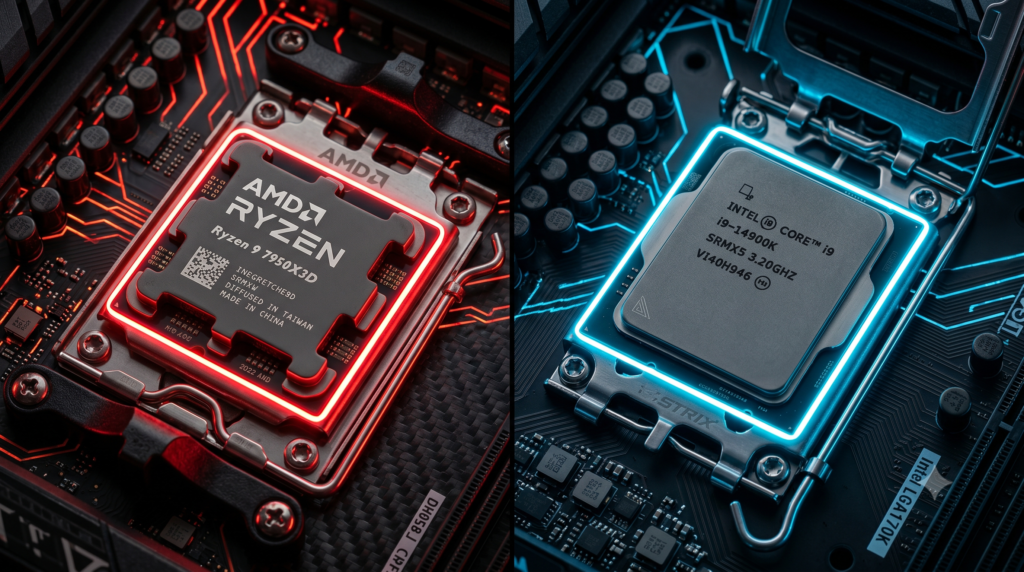
AMD Ryzen 7 7800X3D vs Intel Core i9: Best CPU for Gaming
You just dropped a small fortune on a high-end graphics card like an RTX 4080 or RTX 4090. You load up Cyberpunk 2077 or Warzone, expecting to see buttery-smooth 240+ FPS, but instead, the game stutters, and your frame rate dips wildly during heavy combat. The diagnosis? You have a CPU bottleneck.
Your graphics card is waiting on your processor to deliver game instructions. To fix this, you need a flagship CPU. For years, the undisputed king of the hill was the Intel Core i9. It boasted the highest clock speeds and the most cores. But then, AMD released a piece of alien technology that completely flipped the PC gaming market upside down: the AMD Ryzen 7 7800X3D.
At Desk & Console, we benchmark hardware specifically for gamers. The battle between the 7800X3D and the Intel Core i9 (14900K) isn’t just about speed; it’s a battle of entirely different architectural philosophies. Here is the definitive breakdown of which CPU you should actually put inside your next rig.
1. Spec Check: 3D V-Cache vs P/E Cores
To understand why these CPUs perform differently in games, we need to look at the architectural specs. For this comparison, we are putting AMD’s current gaming king against Intel’s heavy-hitting 14900K.
| Feature | AMD Ryzen 7 7800X3D | Intel Core i9-14900K |
|---|---|---|
| Core/Thread Count | 8 Cores / 16 Threads | 24 Cores (8 P-Cores + 16 E-Cores) |
| Max Boost Clock | Up to 5.0 GHz | Up to 6.0 GHz |
| L3 Cache Size | 96 MB (3D V-Cache) | 36 MB (Smart Cache) |
| Base TDP (Power) | 120W (Extremely Efficient) | 125W (Spikes to 253W+) |
| Motherboard Socket | AM5 (Supported for years) | LGA 1700 (End of Life) |
2. The Secret Weapon: AMD’s 3D V-Cache Explained
If you look at the chart above, you might assume the Intel Core i9 crushes the AMD processor. It has three times as many cores and a much faster clock speed. Yet, in pure gaming benchmarks, the AMD 7800X3D consistently wins. Why? Because of 3D V-Cache.
In a video game, the CPU has to constantly calculate physics, AI, and geometry, pulling that data from your System RAM. This travel time causes latency. AMD solved this by literally stacking an extra layer of memory (Cache) physically on top of the CPU die. The 7800X3D has a massive 96MB of L3 Cache compared to Intel’s 36MB.
Because the CPU can store vast amounts of game data directly on the processor itself, it doesn’t have to wait for the RAM. In “cache-sensitive” games with massive open worlds (like Microsoft Flight Simulator, Escape from Tarkov, Rust, and Cyberpunk 2077), this technology provides a legendary, unmatched boost to frame rates and completely eliminates micro-stutters.
3. Intel’s Strategy: Brute Force & Productivity
Intel takes a completely different approach. Instead of stacking cache, they rely on massive core counts and blistering clock speeds. The Core i9 uses a hybrid architecture, combining “Performance Cores” for gaming and “Efficiency Cores” for background tasks.
While the i9 loses by a few frames in pure gaming scenarios against the 7800X3D, it absolutely obliterates the AMD chip in productivity tasks. If you are a video editor rendering 4K footage in Premiere Pro, compiling 3D models in Blender, or multitasking with broadcasting software, the 24 cores of the Core i9 will finish the job infinitely faster than AMD’s 8 cores.
4. Deep Dive: AMD Ryzen 7 7800X3D
AMD Ryzen 7 7800X3D
If your PC exists for one reason—to play video games at the absolute highest frame rates possible—the AMD Ryzen 7 7800X3D is the undisputed king of silicon. By focusing purely on 8 high-performance gaming cores infused with 3D V-Cache, it delivers untouchable 1% low framerates, ensuring your gameplay never stutters during chaotic firefights.
Beyond raw FPS, the greatest advantage of the 7800X3D is its efficiency. Because it runs at lower voltages, it draws significantly less power than an Intel i9 and runs much cooler. You don’t need a $300 liquid cooler or a 1000W power supply to keep this chip happy. Furthermore, it runs on AMD’s new AM5 motherboard platform, meaning you will be able to upgrade your CPU years from now without buying a new motherboard.
✓ What We Love
- The absolute highest frame rates in modern PC gaming
- 3D V-Cache eliminates stuttering in CPU-heavy simulation games
- Incredibly power-efficient (Runs cool and quiet)
- AM5 platform guarantees years of future upgradeability
✕ Keep in Mind
- With only 8 cores, it is noticeably slower at heavy video rendering
- Requires slightly longer boot times due to DDR5 memory training
5. Deep Dive: Intel Core i9-14900K
Intel Core i9-14900K
If you are a professional content creator, a Twitch streamer running heavy background broadcasting software, or a 3D artist who also loves to game, the Intel Core i9-14900K is an absolute powerhouse. Intel utilizes a “Hybrid Architecture” featuring 8 blazing-fast Performance Cores and 16 Efficiency Cores.
With boost clocks hitting a staggering 6.0 GHz, the i9 completely destroys the AMD 7800X3D in multi-threaded productivity benchmarks (like Cinebench or Adobe Premiere). In gaming, it is only a few frames behind AMD. However, this brute force comes at a massive cost: the i9 requires a top-tier motherboard, a massive power supply, and generates enough heat to warm your entire room.
✓ What We Love
- 24 cores completely dominate heavy productivity workloads
- Insane 6.0 GHz boost clock speeds out of the box
- Elite gaming performance that fully utilizes flagship GPUs
- Flawless multitasking for single-PC Twitch streamers
✕ Keep in Mind
- Draws massive amounts of power (Spikes to 253W+)
- Runs extremely hot; requires an expensive 360mm AIO liquid cooler
- The LGA 1700 motherboard socket is at the end of its life cycle
6. Mandatory Upgrade: AIO Liquid Cooling
ARCTIC Liquid Freezer III 360 AIO Cooler
Whether you choose the 3D V-Cache of AMD or the brute force of Intel, neither of these processors comes with a cooler in the box. If you run the Intel Core i9 on a cheap air cooler, it will instantly hit 100°C and thermal throttle, destroying your gaming performance.
To safely run flagship silicon, you should invest in an AIO (All-in-One) Liquid Cooler. The ARCTIC Liquid Freezer III (360mm) is universally praised as the best CPU cooler on the market. It utilizes a thicker-than-average radiator and a custom VRM fan over the pump to cool your motherboard components, ensuring your chip sustains its maximum boost clocks during long gaming sessions without degrading the hardware.
Buy ARCTIC Liquid Freezer IIIIf your PC is a hybrid workstation used for rendering 4K video, complex 3D modeling, and streaming heavily via software encoders, the Intel Core i9-14900K is the ultimate brute-force productivity powerhouse.
However, if you are building a PC primarily to play games, the AMD Ryzen 7 7800X3D is the undeniable winner. It is cheaper, runs significantly cooler, consumes half the power, and thanks to 3D V-Cache, it delivers the highest raw gaming frame rates on the market today.
Frequently Asked Questions (FAQ)
Does a CPU bottleneck affect 4K gaming?
A CPU bottleneck is highly noticeable at 1080p and 1440p because the graphics card can render frames so incredibly fast that the CPU struggles to keep up. However, at 4K resolution, the workload shifts entirely to the GPU. At 4K, the frame rate gap between the 7800X3D and the Core i9 shrinks significantly, as the graphics card becomes the primary limiting factor.
Why is the Ryzen 7 7800X3D better for gaming than the Ryzen 9?
The Ryzen 7 7800X3D uses a single “Core Complex Die” (CCD) with 3D V-Cache stacked directly on top of all 8 cores. More expensive Ryzen 9 CPUs use two CCDs, meaning gaming workloads can suffer from tiny micro-latencies if they have to cross the ‘bridge’ between the two dies. For pure gaming, the single-die 7800X3D is technically faster and more efficient than its more expensive big brothers.
Will the AM5 motherboard socket last longer than Intel LGA 1700?
Yes. AMD has officially promised to support the AM5 motherboard socket for many years. If you buy a 7800X3D and an AM5 motherboard today, you can simply drop a newer AMD CPU into it 4 years from now. Intel’s LGA 1700 socket is officially “dead,” meaning upgrading an i9-14900K in the future will require buying a brand new motherboard.