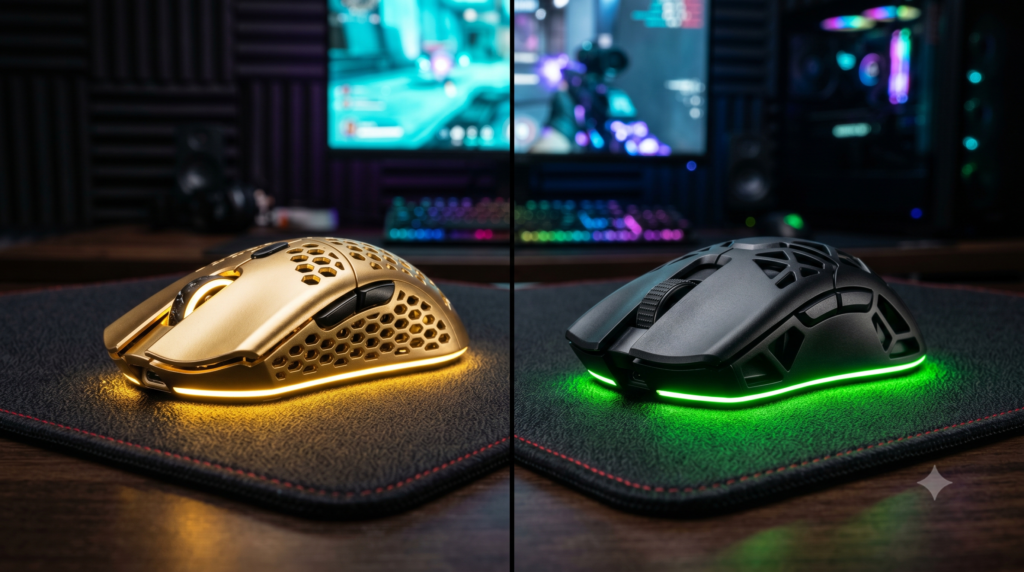
Finalmouse vs Razer Viper Mini Signature Edition: The Magnesium Esports Showdown
The competitive gaming mouse landscape has transitioned from basic weight-reduction holes to advanced aerospace metallurgy. In first-person tactical shooters where micro-adjustments dictate tournament outcomes, heavy shells introduce physical inertia that delays target acquisition. Enthusiast and professional players now demand structural designs that break the 50-gram barrier while maintaining complete chassis rigidity.
Achieving sub-50-gram mass without introducing structural creaking requires evaluating casting alloys, internal web gussets, and wireless transceiver packet scheduling. While optimizing your aiming mechanics with hardware like the best controller thumb grips and precision rings for FPS accuracy assists console hybrid players, pure PC aim relies on zero-latency sensors and uninhibited arm movements.
Pairing an ultra-lightweight magnesium mouse with a spacious desk setup—as explored in our ultimate guide to gaming desks and accessories—gives you the horizontal tracking room necessary to translate low-DPI precision into flawless in-game micro-flicks.
Engineering Analysis: Magnesium Castings vs Carbon Composites
1. Structural Yield Strength
Injection-molded ABS plastic requires 1.2mm wall thickness to prevent shell flex. Cast magnesium alloy achieves higher torsional rigidity at just 0.6mm thickness, allowing open skeletonized cutouts that never bend under aggressive palm force.
2. 8000Hz Polling Packet Scheduling
Moving from 1000Hz to 8000Hz reduces frame-to-frame packet delivery delay from 1.0ms to 0.125ms. However, maintaining consistent packet pacing requires robust USB transceivers that avoid micro-stuttering during sudden high-velocity swipes.
3. Optical Switch Zero-Debounce Speed
Mechanical switches rely on metal leaf contact that requires artificial software debounce delays (2ms to 8ms) to prevent double clicks. Optical switches actuate via infrared beams, registering inputs instantly with zero risk of switch degradation.
Curated Setup Guide & Technical Spec Comparison
| Mouse Model | Weight | Chassis Material | Sensor & Max DPI | Polling Rate Ceiling | Switch Architecture | Best Scenario |
|---|---|---|---|---|---|---|
| Razer Viper Mini SE | 49g | Cast Magnesium Alloy Exoskeleton | Focus Pro 30K Optical | True 8000Hz Wireless | Razer Gen-3 Optical (90M clicks) | Elite competitive play demanding zero chassis flex |
| Finalmouse UltralightX | 29g – 37g | Carbon Fiber Magnesium Composite | PixArt PAW3395 Custom | Up to 8000Hz Wireless | Omron Optical Switches | Extreme sub-ounce speed for pure fingertip aimers |
| WLmouse Beast X | 39g | Skeletonized Magnesium Alloy | PixArt PAW3395 / PAW3950 | Up to 8000Hz Wireless | TTC Nihil Transparent Mechanical | Accessible magnesium design with crisp tactile feedback |
| Razer Viper V3 Pro | 54g | Ultra-Thin Solid Core ABS | Focus Pro 35K Gen-2 Optical | True 8000Hz HyperPolling | Razer Gen-3 Optical (90M clicks) | Production-scale reliability without open honeycomb cutouts |
1. Razer Viper Mini Signature Edition
The Razer Viper Mini Signature Edition is an engineering tour de force. Rather than simply punching hexagonal holes in standard plastic, Razer crafts this flagship from high-grade magnesium alloy using an advanced injection-molding and CNC-milling process. The result is an intricate web-like exoskeleton that weighs just 49 grams while displaying virtually zero side-wall flex or creaking under aggressive grip pressure.
Equipped with Razer Gen-3 Optical Mouse Switches, click execution is instantaneous at 0.2ms actuation with zero debounce delay. The included HyperPolling wireless dongle delivers authentic 8000Hz reporting intervals, translating into remarkably fluid micro-tracking on 360Hz and 540Hz esports monitors. For players using ultra-low click response alongside rapid-trigger keyboards—such as the models featured in our guide to the top 5 mechanical keyboards under 100 for esports—the Viper Mini Signature Edition establishes complete input synchronization.
Strengths
- Cast magnesium alloy skeleton delivers zero shell creak or side-wall deflection
- Razer Gen-3 optical switches eliminate debounce latency and prevent double clicks
- True 8000Hz wireless polling dongle provided standard in the box
- Includes pre-cut Corning Gorilla Glass 3 and PTFE mouse feet sets
Trade-Offs
- Premium luxury price point with limited batch production runs
- Open skeleton requires periodic dust cleaning in humid environments
2. Finalmouse UltralightX Wireless
Finalmouse has consistently pushed the boundaries of mouse weight reduction, and the Finalmouse UltralightX (ULX) represents their most radical design yet. Moving beyond traditional metal casting, the UltralightX utilizes a proprietary carbon-fiber-infused composite material bonded to a lightweight magnesium reinforcement structure. This achieves an astonishing weight class starting at just 29 grams for the small Cheetah footprint.
In-game, moving a sub-30-gram peripheral feels almost weightless. Stopping power is instantaneous, drastically lowering wrist fatigue during long practice routines. A major advantage for competitive purists is the XPanel web configurator, which requires zero local software installations. Gamers seeking an uncluttered operating system experience—similar to the principles outlined in our overview of the best alternatives to Razer Synapse compatible keyboards—will appreciate modifying polling rates, lift-off distance, and DPI stages directly within a lightweight browser tab.
Strengths
- Industry-leading mass reduction down to 29 grams drastically minimizes kinetic inertia
- Driverless XPanel web configurator requires zero background software bloat
- Three physical size options ensure optimal fit across different grip styles
- Crisp Omron optical switches deliver light, spammable primary clicks
Trade-Offs
- Carbon composite shell exhibits minor flex when intentionally compressed at seams
- Drop-style release schedule creates inconsistent retail availability
3. WLmouse Beast X Magnesium Gaming Mouse
For gamers who desire genuine CNC-machined magnesium alloy without paying premium boutique markups, the WLmouse Beast X has disrupted the market. Weighing just 39 grams, the Beast X combines a symmetrical shape heavily inspired by the classic Viper Mini profile with aggressive structural cutouts that maximize ventilation and weight efficiency.
Unlike composite designs, the Beast X feels cool and rigid to the touch. The side walls are reinforced with internal metal cross-ribs, ensuring that even players who use a high-force claw grip experience zero creaking. Supported by a modern Nordic 52840 MCU and an optional 8000Hz dongle, sensor tracking across cloth and hybrid cordura pads remains linear, smooth, and free of jitter.
Strengths
- Genuine CNC-machined magnesium alloy chassis at an accessible price point
- Symmetrical 39g shell mimics the highly regarded Viper Mini ergonomic silhouette
- Nordic 52840 MCU provides reliable wireless stability and responsive 8000Hz polling
- Generous accessory bundle includes multiple glass and PTFE skate varieties
Trade-Offs
- Aggressive open cutouts on the bottom plate expose PCB to external debris
- Battery life is limited to roughly 12 to 16 hours when operating at full 8000Hz
4. Razer Viper V3 Pro Wireless Esports Mouse
While skeletonized magnesium frames dominate boutique discussions, the Razer Viper V3 Pro proves that modern engineering can deliver professional 54-gram weight without cutting a single hole in the exterior shell. Designed in close partnership with Tier-1 esports athletes, the Viper V3 Pro features a solid, uncompromised outer casing that completely seals internal electronics from sweat, dust, and spills.
At its core lies the upgraded Focus Pro 35K Gen-2 sensor, supporting 1-DPI incremental step adjustments and dynamic tracking sensitivity matching. Combined with native 8000Hz wireless polling and large PTFE feet, the Viper V3 Pro provides the balance and grip consistency demanded on competitive tournament stages worldwide.
Strengths
- Solid sealed chassis design prevents internal dust and sweat accumulation
- Updated ergonomic hump provides superior palm support for relaxed claw grips
- Class-leading battery efficiency delivers up to 95 hours of continuous gameplay
- Focus Pro 35K Gen-2 sensor provides flawless tracking on glass and textured cloth
Trade-Offs
- At 54 grams, it is slightly heavier than sub-40g skeletonized magnesium alternatives
- Larger dimensions may feel less nimble for strict fingertip-grip aimers
Technical Verdict: Which Esports Mouse Fits Your Aim Profile?
Choosing between the Razer Viper Mini Signature Edition and the Finalmouse UltralightX comes down to a fundamental choice between structural solidity and extreme weight reduction.
If you want the pinnacle of hardware refinement, zero shell creaking, rock-solid side walls, and proven optical switches that never develop debounce problems, the Razer Viper Mini Signature Edition is the superior all-around competitive tool. Conversely, if your aiming style is built around low-DPI fingertip micro-adjustments where shaving every single gram translates into faster initial flick acceleration, the 29-gram Finalmouse UltralightX remains unmatched in pure speed.
Performance & Gear Hub: Complete Your Setup
An ultra-lightweight esports mouse is only one component of a high-performance gaming battlestation. Explore our companion technical guides to refine your peripheral ecosystem:
Frequently Asked Questions
Does magnesium alloy make a gaming mouse more durable than plastic?
Yes. Magnesium alloy possesses an exceptional strength-to-weight ratio, allowing manufacturers to cast skeletonized web designs with sub-millimeter wall thicknesses that resist structural shell flex under heavy grip pressure. While ultra-thin injection-molded ABS plastic can creak or flex when squeezed, high-grade magnesium unibody frames maintain structural rigidity at weights under 50 grams.
Is true 8000Hz wireless polling noticeable in competitive games like Valorant or CS2?
At 8000Hz, sensor reporting intervals drop from 1.0ms down to 0.125ms. On high-refresh monitors running at 240Hz, 360Hz, or 540Hz, micro-stutters during high-speed tracking are noticeably reduced, providing smoother cursor motion. However, 8000Hz polling substantially increases CPU interrupt utilization and drains mouse battery life up to five times faster than standard 1000Hz operation.
Why do ultra-lightweight mice under 40 grams improve aim consistency?
Reducing mouse mass lowers physical inertia. This minimizes the initial friction required to start micro-adjustments and reduces the kinetic braking force required to stop a rapid flick dead on target. Lower mass reduces wrist and forearm fatigue during extended competitive play sessions, allowing low-DPI arm aimers to maintain higher precision.
Are optical switches superior to mechanical switches in ultra-lightweight mice?
Optical switches actuate via an infrared light beam rather than physical metal contact leaves. This eliminates the necessity of artificial debouncing algorithms, enabling near-zero click latency (under 0.2ms) while completely eliminating double-clicking issues over the lifetime of the mouse.