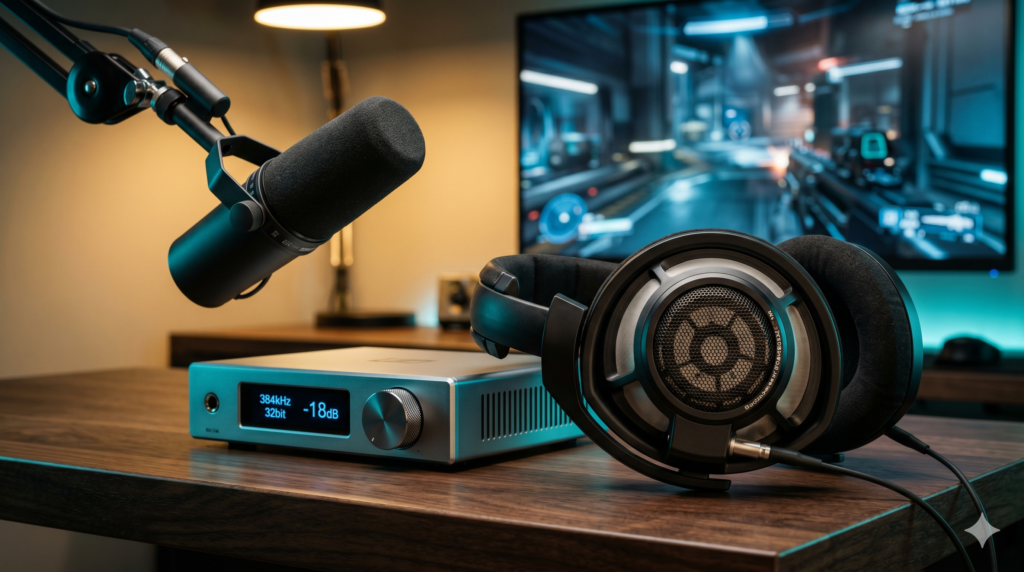
Open-Back vs. Closed-Back Headphones for Competitive FPS Spatial Audio
In competitive first-person shooters like Call of Duty: Warzone, Valorant, or Counter-Strike 2, your eyes can only see roughly 100 degrees in front of you. To survive, you must rely entirely on your ears to “see” the remaining 260 degrees behind and around you. Your audio hardware is literally a tactile radar system.
Yet, millions of PC gamers walk into an electronics store and buy a massive, glowing, plastic “Gaming Headset” with the words “7.1 Virtual Surround Sound” printed on the box. As audio engineers, we can tell you: this is a catastrophic marketing gimmick that is getting you killed in-game.
At Desk & Console, we treat competitive audio as a precise science. If you want true audiophile headphones directional audio gaming tracking, you must abandon software gimmicks and closed plastic cups. You need the raw hardware acoustics of Audiophile Open-Back Headphones. Here is the exact acoustic science of why the competitive elite use them, and the dedicated hardware required to run them.
The Acoustic Physics: Trapped Sound vs. Natural Airflow
The difference between open-back and closed-back headphones is not a software feature—it is pure structural acoustic architecture. It depends entirely on what happens to sound waves after they leave the speaker driver.
🔇 The Closed-Back Bass Trap
A closed-back headset features a solid plastic shell covering the outside of the ear cup. When an explosion or airstrike goes off in-game, the driver pushes a heavy bass wave toward your ear. However, the backside of that soundwave hits the inner plastic shell, bounces backward, and reflects into your ear canal again. This creates Acoustic Resonance. The trapped, booming bass physically drowns out (“masks”) the delicate higher frequencies where footsteps and reloads reside.
🌬️ The Open-Back Air Vent Advantage
An open-back headphone removes the solid plastic shell, replacing it with a breathable metal grille or mesh. When a grenade explodes, the massive bass soundwave hits your ear, and the excess acoustic energy instantly escapes through the grill into the open room. Because the bass waves do not bounce back into your ear, there is zero resonance. Explosions sound tight and fast, completely separating them from the high-mid frequencies. A footstep occurring at the exact same time as an explosion remains crystal clear and perfectly distinct.
Headphone Soundstage vs. Imaging in Warzone
When searching for true directional precision, acoustic engineers judge hardware on two critical spatial metrics: Soundstage and Imaging.
| Acoustic Metric | What It Means | The Competitive FPS Advantage |
|---|---|---|
| Soundstage | The perceived physical width and distance of the audio environment. | DISTANCE: Allows you to know if a sniper is 50 meters away or 200 meters away. (Closed-back headphones have zero soundstage; everything sounds trapped inside your skull). |
| Imaging | The pinpoint directional degree of the audio source. | DIRECTION: Allows you to close your eyes and point to the exact 45-degree angle an enemy is approaching from. Open-backs provide surgical 3D stereo imaging. |
The Best Open-Back Headphones for Call of Duty
These studio-reference headphones lack built-in microphones and aggressive “gamer” branding. Instead, every dollar of their price tag is engineered directly into ultra-fast acoustic drivers and perfectly tuned frequency response curves.
1. Sennheiser HD 560S 🏆 Best Overall Imaging
If you search audiophile forums for the best open back headphones for call of duty, the Sennheiser HD 560S is almost universally the top recommendation for competitive players making their first leap into high-end audio.
These headphones utilize Sennheiser’s Ergonomic Acoustic Refinement (E.A.R.) technology, which angles the speaker drivers slightly backward inside the cup. This perfectly mimics the angle at which sound naturally enters the human ear from physical desk speakers, creating a deeply accurate 360-degree acoustic radar map. Furthermore, at 120 ohms, they are highly efficient and can be run off most modern motherboards or basic streaming interfaces.
Search Sennheiser HD 560S on Amazon2. Beyerdynamic DT 990 Pro (250 Ohm) 🎧 Best Soundstage (Distance)
Walk into a high-end streaming setup, and you will likely see a pair of Beyerdynamic DT 990 Pro headphones. Built in Germany with rugged metal yokes and incredibly plush silver velour earpads, they are famous for remaining comfortable during 10-hour grinds.
If you play massive Battle Royale games where judging distance is critical, the DT 990 Pro features one of the widest soundstages in the audiophile market. You will easily hear gunfights happening multiple POIs away. Warning: The 250-Ohm professional version of the DT 990 Pro requires significant electrical power. You absolutely must pair them with an external Desktop DAC/Amplifier.
Search DT 990 Pro on Amazon3. Audio-Technica ATH-R70x 🌌 Elite Professional Tier
If you have a higher budget and demand absolute endgame 3D mapping, the Audio-Technica ATH-R70x is an undisputed masterclass in spatial audio.
Weighing an impossible 210 grams, it utilizes Audio-Technica’s famous 3D “wing support” system instead of a traditional headband, meaning it literally floats on your head. The acoustically transparent aluminum honeycomb mesh housings provide a wildly immersive soundstage that perfectly reproduces the exact physics of the game engine’s audio cues. At 470 ohms, they are incredibly demanding and strictly require a powerful external amplifier.
Search ATH-R70x on AmazonThe Power Bottleneck: Why You Need an External Desktop DAC
Premium open-back headphones have high “Impedance” (measured in Ohms). Your PC’s motherboard audio chip outputs a pathetic trickle of electricity. If you plug a 250-Ohm DT 990 Pro into your PC, the volume will be incredibly quiet, and the bass will sound distorted and anemic.
To bypass your motherboard’s cheap, electrically noisy onboard sound chip, you must push the raw digital audio via USB to an External DAC (Digital-to-Analog Converter) and Headphone Amplifier stack.
⚡ The Power Engine: FiiO K7 or Schiit Stack
To power studio monitors, you need raw, clean voltage. The FiiO K7 Desktop DAC or a Schiit Audio Stack are the industry standards. They sit stealthily under your monitor, take digital audio from your PC via USB, and deliver pristine THX-grade analog amplification that injects massive “headroom” into your audio, bringing competitive 3D soundstages to life with zero static or hiss.
Search FiiO K7 on Amazon🎙️ The Microphone Problem (And The Professional Solution)
Because true audiophile headphones focus entirely on delivering perfect acoustic sound, they do not feature attached microphones. To communicate in Discord, you must complete your setup with dedicated desktop hardware.
Standalone Dynamic Broadcast Mics
Because open-back headphones leak a tiny amount of audio into the room, you cannot use a cheap condenser microphone (which picks up background noise). You need a Dynamic Broadcast Microphone like the Shure MV7+. Dynamic mics only pick up audio positioned an inch away from the capsule, rejecting 100% of your background keyboard clicks and headphone audio bleed.
Check Shure MV7+ on Amazon →Low-Profile Desk Boom Arm
Do not just set your new microphone on a desk stand; it will pick up the shockwave of your mouse slams. You must suspend it in the air using a Low-Profile (LP) Boom Arm (like the Elgato Wave Mic Arm LP). It clamps to the back of your desk, sweeps underneath your gaming monitors, and hovers right below your chin, giving you flawless comms without blocking your screen.
Check Elgato LP Arm on Amazon →Stop sabotaging your ranked matches with the suffocating, muddy bass of closed-back gaming headsets. By embracing the acoustic physics of open-back ventilation with the Sennheiser HD 560S or Beyerdynamic DT 990 Pro—and powering them via a pristine Desktop DAC—you permanently eliminate bass-masking and unlock the ultimate competitive advantage: perfect 360-degree spatial audio.
Frequently Asked Questions (FAQ)
Open back vs closed back competitive FPS: which is better?
Open-back headphones are vastly superior for competitive FPS. Closed-back headphones trap sound waves inside a plastic cup, causing bass frequencies to bounce and mask the subtle high-mids of footsteps. Open-back headphones allow the sound to escape naturally, creating a pristine, uncompressed sound field where directional audio cues are completely separated from background noise.
What is headphone soundstage vs imaging in Warzone?
Soundstage is the “size” of the audio environment (how far away an airstrike or sniper shot sounds). Imaging is the “pin-point directional accuracy” of the sound (knowing the enemy is exactly at 145-degrees behind a specific wall). You need massive soundstage for distance, and razor-sharp imaging for exact directional tracking.
Do audiophile headphones provide directional audio in gaming?
Yes, audiophile headphones rely on raw, dual-driver hardware acoustics (stereo imaging) to provide pinpoint directional audio. They are infinitely more accurate than “gaming headsets” that rely on bloated, artificial 7.1 virtual surround sound software, which artificially distorts the game’s native audio mix and ruins competitive tracking.